Biodiversity Highlights
Immigrants
No, this is not a rant about small boats, it’s about the beautiful moths and butterflies that have come to us this year. It’s been an exceptional year for migrant moths arriving in the south of England. I have been light-trapping moths in the Leckford and Chilbolton area for past twenty years, but have never seen so many different migrant moth species, and in such numbers.
Most of these are night-flying moths, that we only know about through the use of light-traps. Most years I see a handful of immigrant moth species in my light-traps. But in 2026, I’ve recorded at least twenty immigrant species – all moths that don’t normally breed in this country but arrive during periods of warm weather and favourable, usually southerly winds.
Two of these species have been amazingly numerous. Firstly, I’ve recorded over 500 individuals of the Small Mottled Willow moth (Spodoptera exigua), with sometimes over 30 in one trap. This compares with only 20 individuals recorded in the whole of 2025, and only one or two or none at all in each year from 2016 to 2024.


The second moth that has appeared in numbers, is a pretty little thing called The Vestal (Rhodometra sacraria). Most years I’ve seen a handful, and I noted around 20 individuals in 2017 and 2022. But this year has produced nearly 200 individuals, with a few in every light-trap from the end of July through to late-October. And there have been so many Vestals that because they’re so colourful and conspicuous, it’s been possible to find them in long grass during the daytime when I’ve been counting butterflies.
Some of the others are species I’ve never before seen in this area. The largest of these is the Striped Hawk-moth (Hyles livornica). I only trapped one of these, but another one was found in a conservatory in Chilbolton. The species is known to fly in twilight, and particularly likes to take nectar from garden flowers. So if hot years continue, and you’re sitting in the garden late on a hot summer evening, it will be worth you looking out for what may at first appear to be an exceedingly
large Humming-bird Hawk-moth!


Three other new species for the area were the Plumed Fan-foot (Pechipogo plumigeralis), and two very small moths - the Mugwort Pearl (Loxostege sticicalis), and the very tiny Small Marbled (Eublemma parva).
Of course, some moths are not just found in light-traps, and can be seen in the day-time sunshine. The moth that most of you will have seen is the Humming-bird Hawk-moth (Macroglossum stellatarum). Always fascinating to watch as they hover in front of garden flowers and partake of the nectar, in my garden I’m rarely treated to more than a dozen sightings in a year. But this year the first one appeared in May, and I’ve seen one almost daily – right through to late-October as I write.


You will also probably have seen immigrant butterflies like the Red Admiral (Vanessa Atalanta) and Painted Lady (Vanessa cardui).
There were good numbers this year, but many people were disappointed not to see many of these, and our resident Peacock butterflies (Aglais io), on their garden Buddleja flowers.
This was almost certainly because the very long dry hot weather led to the flowers not offering as much nectar as usual. Another immigrant butterfly, not so often seen in gardens, was the Clouded Yellow (Colias croceus). Most years we see one or two, sometimes none at all. But this year the first ones arrived in May, in time to lay their eggs on Clovers and related plants, and for the larvae to develop quickly in the warm weather and a new generation to appear in abundance. By August time,
at Leckford and on some other farms in the area, I saw thousands of these butterflies flying in the fields of herbal ley. I’ve seen fields full of Clouded Yellows in the past, but only twice before in over 70 years!

So, the obvious questions are: Where do all these moths and butterflies come from? Why do they move such long distances to get here? Why so many this year? And how do such fragile creatures, including some very tiny ones, actually do it? Well, nearly all of them come here from the mainland of Europe, with most crossing the Channel from the south. The Painted Lady butterfly has been studied in detail, and it’s been shown that the butterflies reaching us originate from the Atlas Mountains of North Africa. Well, they’re not the same individuals, but they are the result of successive generations of the butterfly breeding as they move northwards through Spain and France. Most moth species probably do pretty much the same, and many of our immigrant moth species are abundant as breeding species in the south of France. They gradually appear further north through the spring and summer. Individual butterflies and moths may only move a few hundred miles, but the population may advance 2,000 miles between April and August!
Why do they do it at all? Basically, it’s evolution in action! The conditions for success and survival of a species are changing all the time – not just climate, but also competition, predators, habitats. So it’s an evolutionary imperative for most species to spread and disperse to other areas – areas that may previously have been unfavourable, but due to environmental changes may, with luck, have become more favourable. In simple terms, they can be thought of as “searching for the promised
land”! In the northern hemisphere, moths and butterflies invariably move north – to areas where previously they could not have survived the winter, on the chance that conditions will now be better and enable an expansion of the species breeding range and numbers. This is of course especially relevant in this time of warming climate, and even during the twenty years I’ve been light-trapping, several new species that were previously occasion arrivals, have now established breeding populations in Hampshire.
Why so many different moths this year, and in greater numbers than usual? Needless to say, it’s a result of the long hot summer that’s been experienced throughout Europe. Average temperatures in Southern England have been about 2°C above normal. But the French Meteo consider that the temperatures across France have been an incredible 3.6°C above the normal summer average. Almost certainly, the warmth has been favourable to each generation of moths and butterflies breeding quickly, surviving well, and moving north to produce their next generation. So many that wouldn’t normally have made it this far due to periods of cold or wet weather, have reached much further north than normal.
That’s all fine, but how do tiny species such as the Small Marbled with just an 8mm wing-length, manage to fly across the Channel? Evolution again! They’ve evolved to take advantage of the wind. Research using radar (including analysis of some data from the Chilbolton Observatory) has shown that as it gets dark at the right time of the season, migratory moths fly upwards and “test the wind”. If it takes them in an unfavourable direction, they come back down again and stay put. If it takes them in a favourable direction, then they carry on flying upwards to higher altitude where winds are stronger. They are then carried by the wind for hundreds of miles, in much the same way that red dust sometimes comes to us from the Sahara. It’s been shown that even the smallest moths are able to travel in this way at much the same speed as small migratory birds.
For anyone who is particularly interested, here is a list of all the migrant moths (moths that don’t breed near here) that I’ve noted this year in the vicinity of Leckford (in no particular order):
-
Blair’s Mocha (Cyclophora puppillaria)
-
Vestal (Rhodometra sacraria)
-
Portland Ribbon Wave (Idaea degeneraria)
-
L-album Wainscot (Mythimna l-album)
-
Bordered Straw (Heliothis peltigera)
-
Delicate (Mythimna vitellina)
-
Scarce Bordered Straw (Helicoverpa armigera)
-
Small Marbled (Eublemma parva)
-
Rusty-dot Pearl (Udea ferrugalis)
-
Small Mottled Willow (Spodoptera exigua)
-
Cosmopolitan (Leucania loreyi)
-
Plumed Fan-foot (Pechipogo plumigeralis)
-
Olive-tree Pearl (Palpita vitrealis)
-
Sulphur Pearl (Sitochroa palealis)
-
Saltmarsh Knot-horn (Ancylosis oblitella)
-
Rush Veneer (Nomophila noctuella)
-
Mugwort Pearl (Loxostege sticticalis)
-
Striped Hawk-moth (Hyles livornica)
-
Diamond-back Moth (Plutella xylostella)
-
Jersey Mocha (Cyclophora ruficiliaria)
-
Clancy’s Rustic (Caradrina kadenii).
There have also been several species occurring in greater numbers than usual, as a result of a local breeding population being supplemented by arrivals from the continent: Turnip Moth (Agrotis segetum), Dark Sword-grass (Agrotis ipsilon), Rosy Knot-horn (Oncocera semirubella), Beet Moth (Scrobipalpa ocellatella) and Four-spotted Footman (Lithosia quadra).
Glynne Evans, 24th October 2026
Harvest Mice
In February, evidence was found of a new species for the Estate!
As a lover of tall grasses and other vegetation, including tussocky grasslands, hedgerows, cereal field margins, road verges, reed beds and ditches, it is unsurprising that Leckford Estate is perfect habitat for Harvest Mice!
However, looking through our historic data, they have never officially been recorded here before! (It is unclear whether this is due to no surveys ever being undertaken or lack of positive evidence).
The generally accepted survey method is to look for their abandoned nests at the end of the breeding season, when minimal disturbance to the animals can occur.
A solitary non-breeding nest, due to it's smaller size (approx. 5cm in diameter), was found in a field margin on the south side of Winchester Street. This November, 8 larger breeding nests have already been located. Now that presence has been proved, a systematic sampling approach will be in order to establish distribution.

Harvest Mice Breeding Nest
Easter Egg With a Twist!

Great Crested Newt Eggs
This was one of several Great Crested Newt eggs that were found in the Longstock Nursery pond in April.
Newts like to lay their eggs in leaves of horizontal growing, rafting plants in the shallows. The female newt finds a suitable leaf and lays an egg, in the case of GCN's they are a white/creamy colour, with eggs of Smooth and Palmate newts being more greyish/brown.
Once laid, using her back feet she carefully folds the leaf around her egg and secures it by sealing the fold with a secretion for safety from predators.
One female will lay several eggs a day over many weeks and can lay between 150 - 300 eggs in a breeding season. Unfortunately, survival rate isn't high, as the eggs can be predated on by fish, dragonfly larvae and even other amphibians.
Although only one leaf was opened to check the species of Newt, there were 21 other folded leaves counted and we know there is also a population of Smooth Newts in the Nursery Pond too!
Flutterby News
We have two official butterfly transects on the Estate which are part of the UK's Butterfly Monitoring Scheme; a national scheme that collects data from over 2000 sites.
One of which is situated along Fairview Bank, a transect first started in 1989. Unfortunately, this transect has not been completed since 2018, so it was a priority for this route to be reinstated this year.
Being in such close proximity to Stockbridge Down, it is a strategically important transect, that will give insight on movement and dispersal of some of the characteristic chalk downland specialists found on the grasslands above.
Some of the priority species in this ensemble are Grizzled and Dingy Skippers and the Duke of Burgundy butterfly. Fortunately both Grizzled and Dingy Skipper were found. Dingy Skippers have been recorded in low numbers in the past, the last in 2015.
The more pleasing find is that of the Duke of Burgundy! This small butterfly frequents scrubby grassland and sunny woodland clearings, typically in very low numbers. It has declined by over 50% in recent decades and many of the remaining colonies now only have very small populations, as a consequence it now holds an European status of 'Threatened'.
Without accounting for any ad-hoc records we’re yet to discover, this butterfly has only been officially recorded once on this transect and that was in 1991!!

Dingy Skipper

Duke of Burgundy
Southern Damselfly
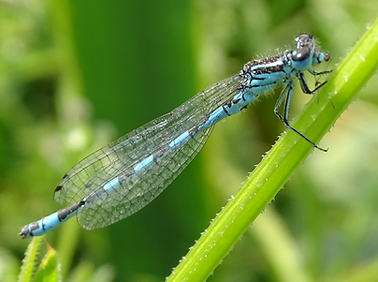
Southern Damselfly
Volunteers from the British Dragonfly Society have been out searching parts of the river valley for the rare Southern Damselfly. The Southern Damselfly is a species that is listed as endangered on the British Odonata Red list with two main strongholds in the New Forest and Pembrokeshire with smaller populations dotted in other counties and along the Rivers Test and Itchen.
Up until a few years ago, the River Test population was thought to only be upstream as far as Mottisfont, but 2 years ago they were found at Stockbridge Common. Over the last 2 seasons, volunteers have been searching upstream to see how far the population is spreading.
Late on a Friday afternoon in June, a small number were recorded at the bottom of the Leckford stretch of the Test, which is great news! Recent sightings have shown that this species is now changing its habitat preferences and inhabiting areas that would have previously been deemed unsuitable!
His Imperial Majesty
A short voicemail left from the Gardens and Grounds Manager, cued a frantic rush to grab binos and camera and to get down to the Water Gardens as quickly as possible.
The mad dash was unnecessary as when I arrived, the rare species in question was happily perched on a visitors ankle and had no intention of moving any time soon!
We had been graced with a visit from a male Purple Emperor (nicknamed in the butterfly world as 'His Imperial Majesty'!). This is a species that usually spends its days high up in the canopy feeding on aphid honeydew and tree sap. The adults are notoriously elusive and males only occasionally descend to the ground to probe for salts from muddy path surfaces and animal dung.
This male was first spotted down on the duck poo around the banks, but we think was later attracted to the skin cream on the ladies leg!

Purple Emperor
Nationally Scarce Moth - Striped Lychnis!

Striped Lynchnis
Over several weeks in July, many people around the estate may have passed Glynne or Kath as they were staring intently at random yellow flowering plants along our road edges!
We hadn’t gone completely mad! We were searching for caterpillars of the Nationally Scarce moth the Striped Lychnis! A UK BAP Priority species, it occurs only in a few scattered localities in the south of England, mainly in chalk or limestone districts. The best monitoring method is to search for the larval foodplant in July & August as the caterpillars will be feeding on the flowers.
This year’s first record for the Striped Lychnis caterpillar was spotted on a lone plant outside the Maintenance & Engineering workshops, but a further 50+ have been counted on Winchester Street. In order to allow the caterpillars to safely pupate ready for emergence next year, it’s important that these areas do not get cut until flowering is over in September. Our Grounds and Gardens Team were happy to accommodate!
The foodplant in question is Dark Mullein, although generally quite widespread, there are only a few locations at Leckford that it has been found, largely along fencelines and road verges.